
If you’ve typed a question into ChatGPT, copied the output, and hesitated before pasting it into your AP Classroom submission portal, this guide is written for you. The question “does AP Classroom detect AI?” has become one of the most-searched queries among high school students and parents navigating Advanced Placement coursework in 2025 and 2026. The short answer is nuanced. The longer answer could protect your academic record.
AP Classroom is College Board’s official learning management platform used by millions of students across the United States and internationally. It houses daily practice questions, teacher-assigned assignments, progress checks, and performance task submissions. Understanding what it can and cannot detect, and what happens when AI-generated content is identified, matters a great deal, especially given the consequences tied to AP scores.
What Is AP Classroom and What Does It Track?
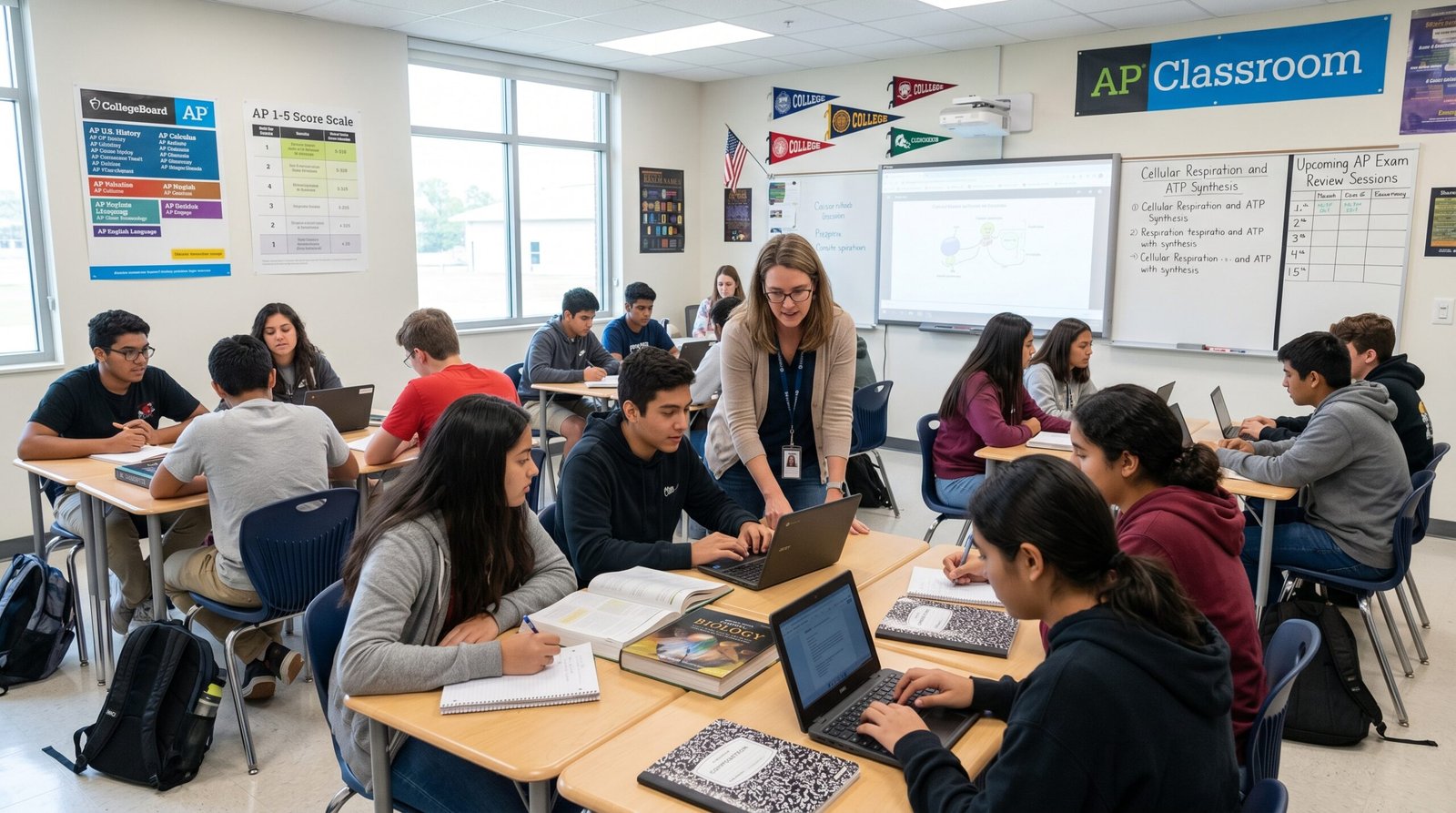
AP Classroom is College Board’s digital hub for AP teachers and students. It is not an independent proctoring platform like ProctorU or Respondus; it does not record your screen during regular assignments, it does not monitor your keystrokes, and it does not deploy AI detection software autonomously.
What it does do is provide a structured environment where:
- Teachers assign and collect formative and summative work.
- Students submit progress checks and free-response practice.
- Performance task components (for AP Capstone courses) are submitted through a connected portal.
- Score data is reported back to College Board for AP exam alignment.
The distinction matters. When people ask “can AP Classroom detect AI,” they are often conflating the submission portal with the broader College Board assessment review infrastructure. The platform itself is not the detector. The review process surrounding it is.
Does AP Classroom Detect AI on Assignments? The Honest Answer
No, and yes. Here is the accurate breakdown:
What AP Classroom Cannot Do
1. It cannot automatically scan submitted text for AI-generated content.
2. It does not run work through tools like Turnitin’s AI detection layer, GPTZero, or Originality.ai by default.
3. It does not flag AI use during daily practice questions or informal assignments.
4. It does not monitor your browser activity, open tabs, or off-platform tools.
What the College Board Process Can Do
1. Human AP readers and graders are trained to notice writing patterns inconsistent with a student’s demonstrated classroom ability.
2. For AP Seminar and AP Research performance tasks, teachers are required to conduct mandatory checkpoints, structured meetings in which students must verbally explain and defend their work. A student who cannot explain what they submitted raises immediate concerns.
3. College Board reserves the right to use “processes and tools” to review work submitted as part of AP performance tasks for evidence of generative AI misuse.
4. Work submitted through the AP Capstone performance task portals can be reviewed by College Board staff, not just teachers.
5. AP Art and Design submissions are reviewed for AI-generated or manipulated imagery.
Official College Board Position: Student work may be flagged for unacceptable use of AI if a student uses generative AI to bypass work. During performance tasks, students must successfully complete checkpoints with their teacher to demonstrate they have not used AI to circumvent the assignment. Failure to complete these checkpoints results in a score of 0 for that component.
How AI Detection Actually Works in the AP System
Understanding the mechanics helps demystify what students are actually at risk for, and what they are not.
1. Human Scoring Remains the Primary Review Layer
AP exams and performance tasks are scored by trained AP readers, typically experienced teachers and college professors. These readers score thousands of responses and develop a sharp instinct for writing that feels totally inconsistent, unusually sophisticated for the demonstrated skill level, or structurally formulaic in the way that AI outputs tend to be. This is not a technology problem. It is a professional judgment one.
2. The Checkpoint System in AP Capstone
AP Seminar and AP Research, the two courses that make up the AP Capstone Diploma Program, require students to complete formal teacher checkpoints before submitting their Individual Research Reports (IRR), Team Multimedia Presentations (TMP), and Academic Papers. These checkpoints require students to:
- Meet with their teacher at scheduled intervals to discuss their research progress.
- Explain their argument, evidence, and methodology in a verbal or written format.
- Demonstrate authentic engagement with source material.
A student who has outsourced their writing to a generative AI tool will typically struggle to defend the work during these conversations. Teachers are explicitly instructed to document whether checkpoints were completed and to report discrepancies to College Board if the submitted work appears inconsistent with what was discussed.
3. Digital Forensics and Content Review
While College Board does not publish the full details of its review methodology, it has confirmed that submitted performance task work can undergo content review that includes pattern analysis. This is consistent with how most major academic institutions now approach AI misuse, not by relying on a single detection tool, but by combining automated pre-screening with human expert review.
External AI detection tools like GPTZero and Turnitin’s AI writing indicator, which teachers independently use at the school level, generate probability scores rather than definitive verdicts. A score indicating likely AI use typically triggers a human review, not an automatic sanction.
AP Courses with the Strictest AI Policies
AI policies vary across AP subjects. Here is a practical overview:
| AP Course / Component | AI Policy Summary |
| AP Seminar (Capstone) | Generative AI to bypass work is prohibited. Checkpoints required. Score of 0 for non-completion. |
| AP Research (Capstone) | Same as Seminar. Research paper, IRR, and presentation must reflect authentic student work. |
| AP Art & Design | Generative AI in the creative process is explicitly prohibited. Portfolio work must be the student’s own. |
| AP Computer Science Principles | AI tools may be used as coding aids for learning, but submitted code and written responses must demonstrate authentic student understanding. |
| AP English Language & Composition | Exam essays are handwritten and timed; AI cannot assist. For teacher-assigned work, school policy applies. |
| All other AP courses | AP exams are handwritten or administered under secure test conditions. AI is not accessible during exams. |
What Counts as Unacceptable AI Use vs. Acceptable Use?
Not all AI use is treated equally. College Board’s guidance makes a critical distinction between using AI as a learning support tool versus using it to substitute for your own thinking and writing.
Unacceptable Uses
- Submitting AI-generated text as your own written response.
- Using AI to generate your research thesis, argument structure, or analysis.
- Copying AI-produced outlines and building your paper directly from them without your own intellectual contribution.
- Using AI to paraphrase sources so you do not have to read them.
- Generating AI images or visual art and presenting them as original work in AP Art portfolios.
Generally Acceptable Uses
- Using AI tools to brainstorm ideas that you then critically evaluate yourself.
- Using grammar or spell-check tools (including AI-enhanced ones like Grammarly) for proofreading.
- Using AI to explain a concept you are struggling to understand, then writing about it in your own words.
- Using AI-assisted coding environments in AP Computer Science to debug syntax errors — while ensuring you understand what the code does.
- Asking an AI tool to summarize a topic to help you decide whether a source is worth reading in full.
Key Principle: The College Board’s position is not anti-AI. It is pro-authentic learning. The question always asks is: does the submitted work reflect what this student knows and can do?
What Happens If AI Use Is Flagged?
The consequences depend on the course, the nature of the submission, and the severity of the misuse.
- For AP Capstone performance tasks, failure to complete teacher checkpoints or submitting work the teacher did not review results in a score of 0 for that component, which can significantly affect the overall AP score and Capstone Diploma eligibility.
- Teachers who identify suspected AI misuse in performance task submissions are required to report this to College Board. College Board may then conduct its own review.
- At the school level, the Code of Academic Integrity applies. Many schools treat AI misuse as equivalent to plagiarism, which can result in failing the assignment, failing the course, or disciplinary action.
- AP exam scores themselves cannot be cancelled by AI detection (since AP exams are administered under secure, proctored, handwritten conditions), but an Academic Integrity investigation can delay score release.
Practical Advice for Students: How to Use AI without Crossing the Line
Here is a workflow that keeps you on the right side of every AP policy:
The Research Phase — AI Is Generally Helpful Here
Use AI tools to build initial familiarity with a topic. Ask an AI chatbot to explain a concept in simple terms, generate a list of possible research angles, or summarize what a historical debate is about. Then go to primary and secondary sources yourself. Your analysis and synthesis must be your own.
The Writing Phase — AI Should Not Write for You
Draft your own work first, even if it is rough. AI tools can then help you improve grammar, check for clarity, or suggest a stronger word choice, but the ideas, argument, and structure should be yours. If a teacher or examiner asked you to explain any paragraph you submitted, you should be able to do so fluently and in your own words.
The Checkpoint Phase — Prepare to Defend Your Work
For AP Seminar and AP Research specifically, treat teacher checkpoints as oral exams on your own paper. Know your sources. Know your argument. Be prepared to explain why you made every major structural or analytical decision in your work. If an AI wrote a section you cannot explain, that is a risk you cannot afford.
The Attribution Question
College Board does not currently require students to cite AI tool use in the same way they cite human sources but transparency is always the safer choice. Some teachers require disclosure of AI tool use even for permissible tasks. When in doubt, ask your teacher. Documentation of how you used AI responsibly can actually protect you if questions arise later.
The Bottom Line
AP Classroom does not automatically detect AI-generated writing. There is no passive scanner running in the background of every submission flagging GPT-style outputs. The real detection mechanism is human: trained AP readers who score work, teachers who conduct checkpoints, and College Board staff who review high-stakes performance task submissions.
That does not mean the risk is low. It means the risk is human-shaped. A student who submits AI-generated work and cannot defend it during a checkpoint meeting or whose writing reads dramatically differently from their in-class performance is at significant risk, not from a bot, but from a professional educator who recognizes authentic learning when they see it.
The safest path is the simplest one: use AI tools to understand, not to replace. Let them accelerate your research and sharpen your language. But let your thinking, your argument, and your voice stay yours. That is what AP assessments are measuring, and it is the work that no AI; however sophisticated, can genuinely do on your behalf.