
Students across the US worry about submitting AI-assisted work in AP courses. Many want a clear answer before their next assignment deadline hits. So, does AP Classroom detect AI on assignments?
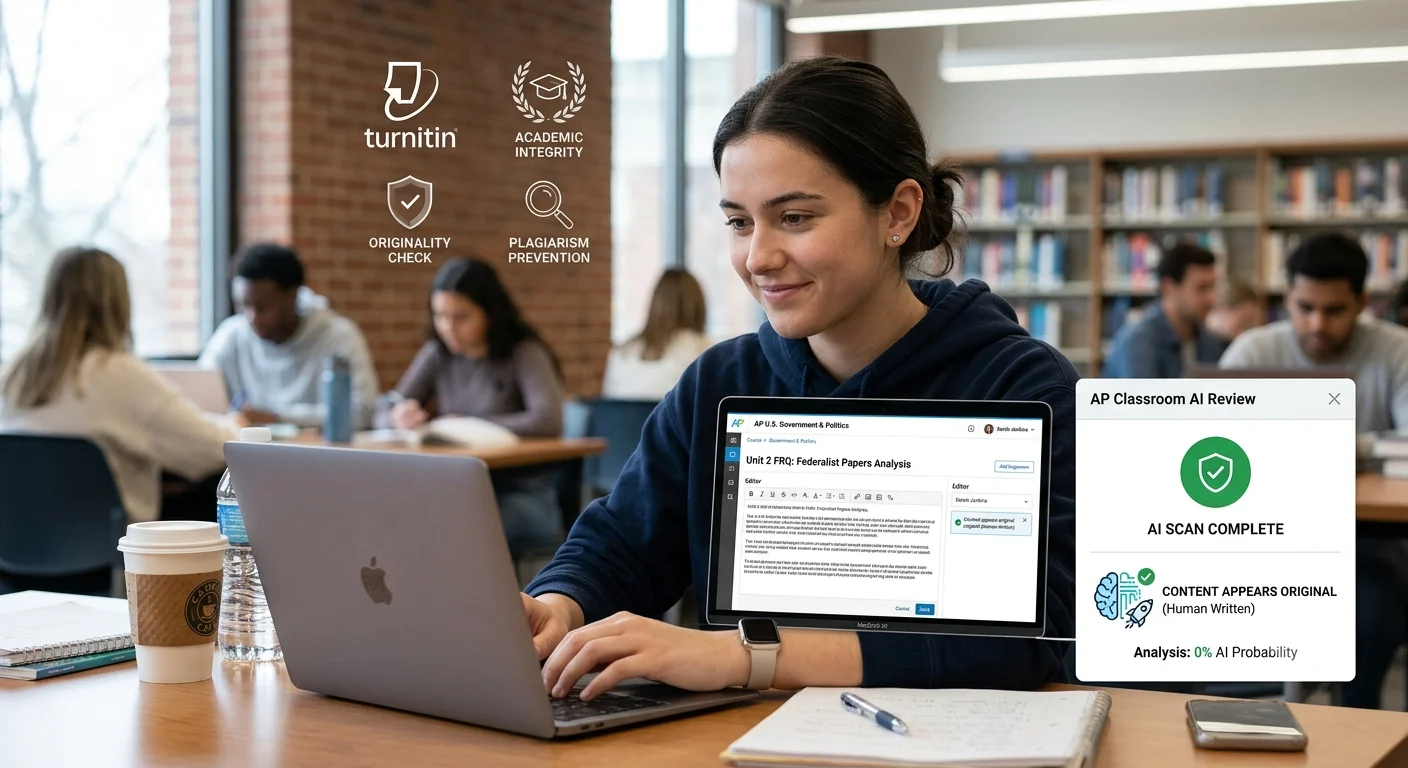
The simple answer is, no. The platform has no built-in AI detection at all. But the College Board actively uses powerful external tools that catch AI content fast.
Turnitin alone has already processed over 50 million academic submissions worldwide. Understanding exactly how this detection ecosystem works could genuinely save a student’s academic record.
What AP Classroom Is Actually Designed to Do
AP Classroom is the College Board’s official digital hub for AP students and teachers. It delivers practice questions, instructional videos, progress checks, and teacher-assigned tasks smoothly.
The platform focuses entirely on learning delivery and assessment management for AP courses. AI content detection in AP Classroom was never part of its original design blueprint.
Teachers cannot depend on the platform alone to identify AI-generated student submissions. That gap is exactly why external detection methods have become so critically important today.
How the College Board Catches AI Use Outside the Platform
The College Board combines external software tools with direct teacher judgment effectively. Turnitin AI detection remains the most widely used method across AP course submissions.
It analyzes writing patterns that machine-generated text consistently produces at a statistical level. Teachers also manually review work for sudden tone shifts and unusual vocabulary choices.
Several AP courses include checkpoint systems requiring students to explain their own reasoning. Students who didn’t write the work themselves struggle significantly at those checkpoint stages.
How Turnitin Actually Identifies AI-Written Assignments
Turnitin claims approximately 98% accuracy when identifying AI-generated content in student work. It compares submitted text against natural human writing variations and predictable language patterns.
The tool identifies both fully AI-written submissions and mixed human-plus-AI content equally well.
Students producing research-heavy writing can get genuine help from an Essay Writing Service without any integrity risk. Turnitin now functions as a serious academic integrity enforcement tool far beyond basic plagiarism scanning alone.
Course-Specific AI Policies Most Students Completely Overlook
Not every AP course handles AI use in assignments under the exact same rules. AP Art and Design prohibits AI tools entirely because original creativity defines the course.
AP Computer Science Principles permits limited AI use only for understanding core concepts. AP Seminar and AP Research allow AI during early research stages but never in final submissions.
Missing these course-specific rules is where students make the most expensive academic mistakes. Consequences vary by course but carry serious weight across every single AP subject.
What Really Happens After AI Gets Detected in AP Work
The consequences of AI detection in AP courses range from uncomfortable to genuinely career-altering. Minor violations typically result in a zero score on that specific assignment component.
Serious violations lead to full exam cancellation with reports sent directly to colleges. Severe or repeated cases can permanently ban students from all future AP exams entirely.
That ban creates lasting damage to college admission prospects and scholarship opportunities simultaneously. Most students dramatically underestimate how seriously the College Board pursues AP academic integrity violations every year.
The False Positive Problem That Rarely Gets Discussed
Turnitin carries an acknowledged false positive rate of around 4% per sentence on submissions. Vanderbilt University actually disabled Turnitin’s AI detector specifically because of accuracy concerns.
Research shows AI detectors falsely flag 61% of essays written by non-native English speakers. Those students naturally write in structured patterns that detection algorithms misread as machine output.
Even completely original human writing carries real detection risk under current AI scanning tools. This remains one of the most serious unresolved problems in AI detection and academic fairness today.
Does AP Classroom Actually Monitor Browser or Split-Screen Activity
AP Classroom browser monitoring does not exist natively within the platform at all. Tab switching and split-screen use go completely undetected inside AP Classroom during regular work.
School-issued devices often run GoGuardian or Respondus LockDown Browser completely separately from the platform. Those school-level tools operate independently and have nothing to do with AP Classroom itself.
Students on personal devices face significantly less active monitoring during standard AP assignments. Proctored in-school exams operate under entirely stricter and more controlled monitoring conditions.
Smart Ways to Protect Academic Standing in AP Courses
Submitting genuinely original work remains the only truly risk-free approach in any AP course. Keeping drafts, revision notes, and writing history demonstrates authentic development to any reviewing teacher.
Active classroom participation proves real understanding in ways that AI-generated text never can. Proper citations and high-authority sources significantly strengthen the credibility of any AP submission.
Students managing heavy AP workloads can explore The Best Assignment Writing Service in USA for legitimate and safe academic support. Building real writing skills always matters far more than shortcuts carrying serious long-term academic risk.
Why the College Board Takes AI Integrity So Seriously
The College Board launched its own GenAI Studio specifically to help educators use AI responsibly. The core issue has always been whether submitted work reflects genuine student thinking and effort.
College Board AI policies exist to protect what AP credentials actually mean to colleges and universities. Using AI as a shortcut directly undermines the purpose of enrolling in AP courses at all.
Students who genuinely engage with coursework build skills that serve them throughout college and careers. Detection systems are improving rapidly and the stakes attached to violations keep rising every semester.
FAQs
Does AP Classroom detect AI on assignments directly?
No, AP Classroom has zero built-in AI detection capability on its own. The College Board relies on external tools like Turnitin to identify AI-generated student work.
Can teachers manually identify AI-written AP work?
Yes, teachers compare current submissions against a student’s past writing style and tone. Checkpoint systems also require students to explain their own reasoning process directly.
What consequences follow AI detection in AP courses?
Penalties range from a component zero to full exam cancellation reported to colleges. Severe or repeated violations can result in a permanent AP exam ban.
Is Turnitin accurate enough to use as sole evidence?
Turnitin claims 98% accuracy but carries a real 4% per-sentence false positive rate. Vanderbilt University disabled its AI detector entirely because of these reliability concerns.
Can AP Classroom detect tab switching or split-screen use?
No, AP Classroom does not monitor tab switching or split-screen activity at all. School-installed tools like GoGuardian can track this separately on school-issued devices only.
Do non-native English speakers face unfair AI detection flags?
Yes, studies show detectors falsely flag 61% of non-native English speaker essays. Their structured grammar patterns statistically resemble AI output to detection algorithms.
Which AP courses carry the strictest AI usage policies?
AP Art and Design bans AI entirely with no exceptions whatsoever. AP Seminar and AP Research enforce the most detailed AI restrictions across every submission stage.